Rates, dates and model comparison
Data and models are taken from the BEAST documentation, though we tweak priors.
The first step is to read in the sequence alignment from a file in the Nexus format. A range of other alignment formats, including FASTA, are supported.
[1]:
from treeflow import Alignment, AlignmentFormat

alignment = Alignment("demo-data/YFV.nex", format=AlignmentFormat.NEXUS)
alignment
Silencing TensorFlow...
[1]:
Alignment(taxon_count=71, pattern_count=654)
Currently, only fixed-topology inference algorithms are implemented in TreeFlow. The library is designed to support topology inference by treating the topology as a Tensor variable, but here we leave it fixed. The topology we use was obtained by building a maximum-likelihood unrooted phylogeny using RAxML and rooting it using LSD, accounting for the sampling times of the sequences. The pipeline for inferring topologies is implemented as a command line application in the repository for the TreeFlow publication.
The tree that LSD outputs has the sampling times which are parsed from the taxon names. The output of parse_newick is an instance of the NumpyRootedTree class, which is a data class that holds a Numpy array of internal node heights (node_heights), leaf node sampling times (sampling_times), and the tree topology (topology). The tree topology is also a data class with index vectors representing the parent indices of nodes, and a preorder traversal of the tree.
The tree also determines an ordering of the taxa in the alignment (taxon_set), is used to encode the alignment as a one-hot TensorFlow Tensor.
[2]:
from treeflow import parse_newick

starting_tree = parse_newick("demo-data/YFV.newick")
sequence_tensor = alignment.get_encoded_sequence_tensor(starting_tree.taxon_set)
sequence_tensor.shape
[2]:
TensorShape([654, 71, 4])
We define a model using TreeFlow’s YAML model definition format. As we can see from the model definition string model_string, we are using a strict clock rate model, Gamma site rate variation with four categories, a HKY substitution model, and a coalescent tree prior with a constant population size. We place log-Normal priors on all the parameters (except the substitution model frequencies which have a
Dirichlet prior).
We parse the model definition string into a nested dictionary using Python’s yaml library, and pass that to TreeFlow’s PhyloModel class constructor. This class is converted into a TensorFlow Probability’s JointDistribution using phylo_model_to_joint_distribution. This joint distribution class implements methods like log_prob and sample. The final statement of this code block examines the composition of samples from this joint distribution; it is a nested structure of
Tensors which represent the variables of the model. The type of this structure is generated by tensorflow_probability’s `JointDistributionCoroutine <https://www.tensorflow.org/probability/api_docs/python/tfp/distributions/JointDistributionCoroutine>`__. Later we’ll examine a different joint distribution type which produces a slightly different structure of Tensors (a Python dictionary).
The tree variable of the model JointDistribution is an instance of the TensorflowRootedTree class, which a version of NumpyRootedTree which has TensorFlow Tensors instead of Numpy arrays.
Currently the sampling of the coalescent tree and alignment distributions are dummy methods which samples zeros in the expected shape of the alignment, which yield “Dummy sampling” warnings - the inference methods currently implemented in TreeFlow do not require actual simulation of these variables.
[3]:
import yaml
import tensorflow as tf
from treeflow import (
    PhyloModel,
    convert_tree_to_tensor,
    phylo_model_to_joint_distribution
)

model_string = """
clock:
  strict:
    clock_rate:
      lognormal:
        loc: -2.0
        scale: 2.0
site:
  discrete_gamma:
    category_count: 4
    site_gamma_shape:
      lognormal:
        loc: 0.0
        scale: 1.0
substitution:
  hky:
    kappa:
      lognormal:
        loc: 1.0
        scale: 1.25
    frequencies:
      dirichlet:
        concentration:
        - 2.0
        - 2.0
        - 2.0
        - 2.0
tree:
  coalescent:
    pop_size:
      lognormal:
        loc: 1.0
        scale: 1.5
"""

model_dict = yaml.safe_load(model_string)
model = PhyloModel(model_dict)
starting_tensor_tree = convert_tree_to_tensor(starting_tree)
model_dist = phylo_model_to_joint_distribution(model, starting_tensor_tree, alignment)
model_dist_sample = model_dist.sample()
tf.nest.map_structure(lambda x: x.shape, model_dist_sample)
/home/christiaan/uni/treeflow/treeflow/distributions/tree/coalescent/constant_coalescent.py:133: UserWarning: Dummy sampling
  warnings.warn("Dummy sampling")
/home/christiaan/uni/treeflow/treeflow/tf_util/attrs.py:7: UserWarning: Temporary hotfix
  warnings.warn("Temporary hotfix")
/home/christiaan/uni/treeflow/treeflow/distributions/leaf_ctmc.py:62: UserWarning: Dummy sampling of alignment
  warnings.warn("Dummy sampling of alignment")
[3]:
StructTuple(
  pop_size=TensorShape([]),
  tree=TensorflowRootedTree(node_heights=TensorShape([70]), sampling_times=TensorShape([71]), topology=TensorflowTreeTopology(parent_indices=TensorShape([140]), child_indices=TensorShape([141, 2]), preorder_indices=TensorShape([141]))),
  kappa=TensorShape([]),
  frequencies=TensorShape([4]),
  clock_rate=TensorShape([]),
  site_gamma_shape=TensorShape([]),
  alignment=TensorShape([654, 71, 4])
)
We can perform Bayesian inference on this model (given a fixed tree topology) using Automatic Differentiation Variational Inference. The fit_fixed_topology_variational_approximation automatically constructs an approximation to the posterior distribution that assumes independence between variables. It then minimises the KL divergence between this and the true posterior using stochastic gradient descent.
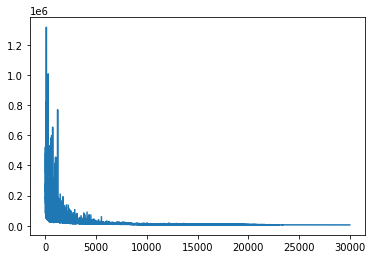
The RobustOptimizer class ensures that an occasional numerical overflow (which is fairly likely when computing phylogenetic likelihoods) does not ruin our optimization run. We plot the (stochastic) trace of the loss function to check convergence.
[4]:
from treeflow.vi import fit_fixed_topology_variational_approximation, RobustOptimizer
from tqdm import tqdm
import matplotlib.pyplot as plt

model_dist_pinned = model_dist.experimental_pin(alignment=sequence_tensor)
optimizer = RobustOptimizer(tf.optimizers.Adam(learning_rate=0.001))
num_steps = 30000
approx, (loss, approx_vars) = fit_fixed_topology_variational_approximation(
    model_dist_pinned,
    topologies=dict(tree=starting_tensor_tree.topology),
    optimizer=optimizer,
    num_steps=num_steps,
    init_loc=dict(tree=starting_tensor_tree),
    progress_bar=tqdm
)
plt.plot(loss)
/home/christiaan/uni/treeflow/treeflow/tf_util/attrs.py:7: UserWarning: Temporary hotfix
  warnings.warn("Temporary hotfix")
100%|████████████████████████████████████████████████████████████████████████████████████████████████████████████████████████████████████████████████████████████████████████| 30000/30000 [15:18<00:00, 32.65it/s]
[4]:
[<matplotlib.lines.Line2D at 0x7f70983500d0>]
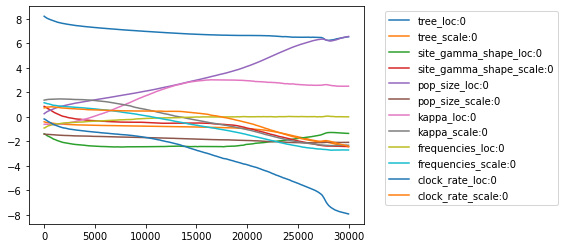
The approx_vars variable records a trace of the parameters of the variational approximating distribution. We can plot these over the course of the optimisation as a further check for convergence. Here we just plot the last index of each of the vector variables, the tree (where it corresponds to the root height) and the frequencies. Each variable has a location and scale parameter for the underlying Normal distribution. These are transformed to fit the appropriate domain for the model
variables.
[5]:
for varname, value in approx_vars.items():
    np_value = value.numpy()
    if len(np_value.shape) > 1:
        np_value = np_value[:, -1]
    plt.plot(np_value, label=varname)
plt.legend(bbox_to_anchor=(1.05, 1), loc='upper left')
[5]:
<matplotlib.legend.Legend at 0x7f700137a310>
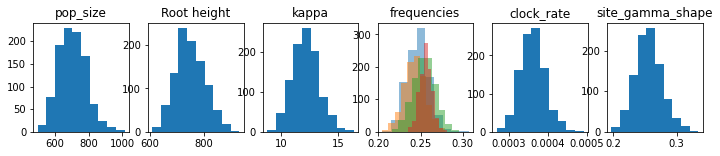
The easiest way to inspect parameter estimates is through samples from the approximating distribution. We get the variable names from the base model distributions _flat_resolve_names method.
[7]:
approx_samples = approx.sample(1000)
varnames = model_dist_pinned._flat_resolve_names()
fig, axs = plt.subplots(ncols=len(varnames), figsize=(12, 2))
for ax, varname, samples in zip(axs, varnames, approx_samples):
    np_value = samples.numpy()
    if varname == "tree":
        np_value = samples.node_heights[:, -1]
        ax.set_title("Root height")
    else:
        ax.set_title(varname)

    if len(np_value.shape) > 1:
        for i in range(np_value.shape[-1]):
            ax.hist(np_value[:, i], alpha=0.5)
    else:
        ax.hist(np_value)
/home/christiaan/uni/treeflow/treeflow/tf_util/attrs.py:7: UserWarning: Temporary hotfix
  warnings.warn("Temporary hotfix")
We can output the inferred trees in the Nexus format using the write_tensor_trees function, and visualize or analyze them with other software.
[9]:
import pathlib
from treeflow import write_tensor_trees

output_folder = pathlib.Path("demo-out")
output_folder.mkdir(exist_ok=True)

write_tensor_trees(
    "demo-data/YFV.newick",
    approx_samples.tree.branch_lengths,
    output_folder / "YFV-trees.nexus",
)
Try model with sequences partitioned into codon
We can try an alternative substitution model by partitioning the alignment into codon positions and estimating separate substitution model parameters for each of them. We can use statistical model selection to compare the support the data has for the model with more parameters.
[6]:
codon_partitioned_sequence_tensor = alignment.get_codon_partitioned_sequence_tensor(starting_tree.taxon_set)
codon_partitioned_sequence_tensor.shape
[6]:
TensorShape([3, 218, 71, 4])
We declare a new model using TensorFlow Probability’s `JointDistributionNamed <https://www.tensorflow.org/probability/api_docs/python/tfp/distributions/JointDistributionNamed>`__. This implements a joint distribution over a structure of Tensors, constructed using a dictionary of TensorFlow Probability Distributions or Distribution-building functions.
kappa/frequencies/site_gamma_shape/pop_size/clock_rate: for brevity, we re-use the priors from the previous model, modifying thekappaandfrequenciesfor the parameters with theSamplemeta-distribution. This represents independent identically-distributed samples based on a single base distribution for each of the codon positions.tree: We use theConstantCoalescenttree distribution implemented bytreeflowfor the distribution on the phylogenetic tree.alignment: thebuild_codon_alignment_distributionfunction, which builds the distribution on the observed sequences, makes the structure of this part of the model clear:It first constructs an unrooted tree of genetic distances (in units of expected substitutions per site), which is the product of the branch lengths on the time tree and the constant mutation rate
This is used to compute transition probabilities between each of the nodes of the tree using the substitution model parameters. A mixture over a discretized Gamma distribution is used to model site-rate variation
The
LeafCTMCclass implements the phylogenetic likelihood which marginalizes over the characters at internal nodes usingThe
Independentmeta-distribution indicates the distribution is independent over the codon position batch dimension and the log-likelihoods should summed over this dimensionThe
Samplemeta-distribution represents the identical indendependent samples of the single-codon distribution over the codons
[7]:
import tensorflow_probability as tfp
tfd = tfp.distributions
from treeflow.distributions import DiscretizedDistribution, SampleWeighted, DiscreteParameterMixture, LeafCTMC
from treeflow.evolution.substitution import HKY, get_transition_probabilities_tree
from treeflow.distributions.tree import ConstantCoalescent

codon_size = codon_partitioned_sequence_tensor.shape[0]
dist_dict = { dist.name: dist for dist in model_dist._get_single_sample_distributions() }

codon_size, codon_count, taxon_count, site_category_count = codon_partitioned_sequence_tensor.shape
subst_model = HKY()

def build_codon_alignment_distribution(kappa, frequencies, tree, clock_rate, site_gamma_shape):
    distance_tree = tree.get_unrooted_tree() * clock_rate
    site_rate_distribution = DiscretizedDistribution(
        category_count=site_category_count,
        distribution=tfd.Gamma(concentration=site_gamma_shape, rate=site_gamma_shape),
    )
    transition_probs_tree = get_transition_probabilities_tree(
        distance_tree,
        subst_model,
        rate_categories=site_rate_distribution.normalised_support,
        frequencies=frequencies,
        kappa=kappa
    )
    batch_ctmc = LeafCTMC(
        transition_probs_tree,
        tf.expand_dims(frequencies, -2) # Add a dimension to frequencies to broadcast with site rate mixture
    )
    site_rate_mixture = DiscreteParameterMixture(
        site_rate_distribution,
        batch_ctmc,
    )
    single_site_dist = tfd.Independent(site_rate_mixture, reinterpreted_batch_ndims=1)
    return tfd.Sample(
        single_site_dist,
        sample_shape=codon_count,
    )

codon_model_dist = tfd.JointDistributionNamed({
    "pop_size": dist_dict["pop_size"],
    "kappa": tfd.Sample(dist_dict["kappa"], sample_shape=codon_size),
    "frequencies": tfd.Sample(dist_dict["frequencies"], sample_shape=codon_size),
    "site_gamma_shape": dist_dict["site_gamma_shape"],
    "clock_rate": dist_dict["clock_rate"],
    "tree": lambda pop_size: ConstantCoalescent(starting_tensor_tree.taxon_count, pop_size, starting_tensor_tree.sampling_times, tree_name="tree"),
    "alignment": build_codon_alignment_distribution
})
codon_model_dist.event_shape
/home/christiaan/uni/treeflow/treeflow/distributions/tree/coalescent/constant_coalescent.py:133: UserWarning: Dummy sampling
  warnings.warn("Dummy sampling")
/home/christiaan/uni/treeflow/treeflow/distributions/leaf_ctmc.py:62: UserWarning: Dummy sampling of alignment
  warnings.warn("Dummy sampling of alignment")
[7]:
{'pop_size': TensorShape([]),
 'tree': TensorflowRootedTree(node_heights=TensorShape([70]), sampling_times=TensorShape([71]), topology=TensorflowTreeTopology(parent_indices=TensorShape([140]), child_indices=TensorShape([141, 2]), preorder_indices=TensorShape([141]))),
 'site_gamma_shape': TensorShape([]),
 'kappa': TensorShape([3]),
 'frequencies': TensorShape([3, 4]),
 'clock_rate': TensorShape([]),
 'alignment': TensorShape([218, 3, 71, 4])}
To match the shape of the alignment distribution, we use tf.transpose to swap the first two dimensions (codon index and codon position) of the codon-partitioned encoded alignment Tensor - this is necessary because the Sample distribution over codons can only add a outer/left-most dimension. We then pin (condition on) the observed alignment and test the conditional log-likelihood.
[8]:
site_first_codon_sequence_tensor = tf.transpose(codon_partitioned_sequence_tensor, [1, 0, 2, 3])
codon_model_dist_pinned = codon_model_dist.experimental_pin(alignment=site_first_codon_sequence_tensor)
codon_prior_sample = codon_model_dist.sample()
codon_prior_sample.pop("alignment")
codon_prior_sample["tree"] = starting_tensor_tree
codon_model_dist_pinned.log_prob(codon_prior_sample)
[8]:
<tf.Tensor: shape=(), dtype=float64, numpy=-66077.80179853331>
Using the same inferential machinery as before, we fit an approximating distribution to the posterior.
[9]:
codon_optimizer = RobustOptimizer(tf.optimizers.Adam(learning_rate=0.001))
codon_approx, (codon_loss, codon_approx_vars) = fit_fixed_topology_variational_approximation(
    codon_model_dist_pinned,
    topologies=dict(tree=starting_tensor_tree.topology),
    optimizer=codon_optimizer,
    num_steps=num_steps,
    init_loc=dict(tree=starting_tensor_tree),
    progress_bar=tqdm,
    approx_kwargs=dict(var_name_prefix="codon_"),
)
plt.plot(codon_loss)
100%|████████████████████████████████████████████████████████████████████████████████████████████████████████████████████████████████████████████████████████████████| 30000/30000 [15:16<00:00, 32.73it/s]
[9]:
[<matplotlib.lines.Line2D at 0x7f7887e3dfa0>]
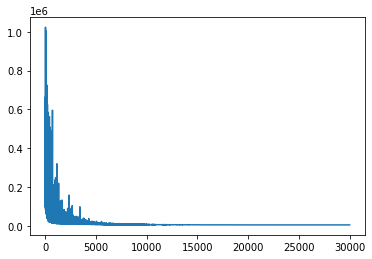
We can compare parameter estimates beween the two models, and see that the estimates of the height of the root of the tree and the clock rate differ slightly between the base and codon-partitioned models, at least under the results of our inference procedure.
[69]:
codon_approx_samples = codon_approx.sample(1000)
fig, axs = plt.subplots(ncols=len(varnames), figsize=(12, 2))
for ax, varname, samples in zip(axs, varnames, approx_samples):
    np_value = samples.numpy()
    codon_np_value = codon_approx_samples[varname].numpy()
    if varname == "tree":
        np_value = np_value.node_heights[:, -1]
        codon_np_value = codon_np_value.node_heights[:, -1]
        ax.set_title("Root height")
    else:
        ax.set_title(varname)

    if varname == "kappa":
        ax.hist(np_value, label="Base", alpha=0.5, density=True)
        for i in range(codon_size):
            ax.hist(codon_np_value[:, i], label=f"Codon {i}", alpha=0.5, density=True)
    elif varname != "frequencies":
        ax.hist(np_value, label="Base", alpha=0.5, density=True)
        ax.hist(codon_np_value, label="Codon", alpha=0.5, density=True)
    ax.legend(loc='upper center', bbox_to_anchor=(0.5, -0.15))
WARNING:matplotlib.legend:No artists with labels found to put in legend. Note that artists whose label start with an underscore are ignored when legend() is called with no argument.
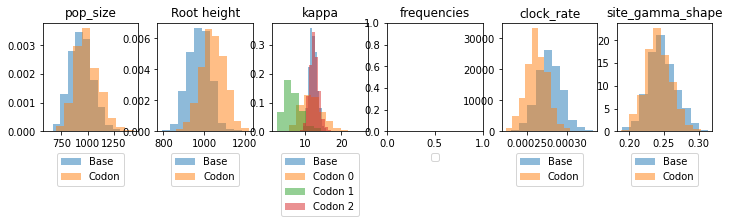
We can use the (log) marginal likelihood to compare the fit of the two models to the observed data. While the negative of the objective function used in inference does provide an estimate (a lower bound) on the marginal likelihood, we can improve the estimate using importance sampling. This is implemented in the estimate_log_ml_importance_sampling method. We can see that the marginal likelihood for the codon-partitioned model is slightly higher, which indicates that it is a better
explanation for the observed data despite having more parameters.
The vectorize_log_prob argument can be set to False to save memory if required.
Note: this method currently results in a large number of “ignored” exceptions deep inside TensorFlow Probability code but it doesn’t appear these affect the results
[10]:
import yaml
from treeflow.vi import estimate_log_ml_importance_sampling

ml_n_samples = 100
base_ml_result = estimate_log_ml_importance_sampling(model_dist_pinned, approx, vectorize_log_prob=False, n_samples=ml_n_samples)
codon_ml_result = estimate_log_ml_importance_sampling(codon_model_dist_pinned, codon_approx, vectorize_log_prob=False, n_samples=ml_n_samples)

marginal_likelihood_dict = dict(
    base=base_ml_result.numpy(),
    codon=codon_ml_result.numpy()
)
marginal_likelihood_dict
Exception ignored in: <bound method WeakStructRef._cleanup of WeakStructRef(StructTuple(
  pop_size=HashableWeakRef(<weakref at 0x7f7887783c20; dead>),
  tree=HashableWeakRef(<weakref at 0x7f7887783770; dead>),
  kappa=HashableWeakRef(<weakref at 0x7f7887783d10; to 'Tensor' at 0x7f7887316430>),
  frequencies=HashableWeakRef(<weakref at 0x7f7887783db0; to 'Tensor' at 0x7f78873167f0>),
  clock_rate=HashableWeakRef(<weakref at 0x7f7887783ea0; to 'Tensor' at 0x7f78873b12b0>),
  site_gamma_shape=HashableWeakRef(<weakref at 0x7f7887783ef0; to 'Tensor' at 0x7f78872d1d90>)
))>
Traceback (most recent call last):
  File "/home/christiaan/.pyenv/versions/3.8.13/envs/treeflow/lib/python3.8/site-packages/tensorflow_probability/python/internal/cache_util.py", line 151, in _cleanup
    self._callback(self)
  File "/home/christiaan/.pyenv/versions/3.8.13/envs/treeflow/lib/python3.8/site-packages/tensorflow_probability/python/internal/cache_util.py", line 221, in maybe_del
    del self[key]
KeyError: WeakStructRef(StructTuple(
  pop_size=HashableWeakRef(<weakref at 0x7f7887783c20; dead>),
  tree=HashableWeakRef(<weakref at 0x7f7887783770; dead>),
  kappa=HashableWeakRef(<weakref at 0x7f7887783d10; to 'Tensor' at 0x7f7887316430>),
  frequencies=HashableWeakRef(<weakref at 0x7f7887783db0; to 'Tensor' at 0x7f78873167f0>),
  clock_rate=HashableWeakRef(<weakref at 0x7f7887783ea0; to 'Tensor' at 0x7f78873b12b0>),
  site_gamma_shape=HashableWeakRef(<weakref at 0x7f7887783ef0; to 'Tensor' at 0x7f78872d1d90>)
))
Exception ignored in: <bound method WeakStructRef._cleanup of WeakStructRef(StructTuple(
  pop_size=HashableWeakRef(<weakref at 0x7f7887783c20; dead>),
  tree=HashableWeakRef(<weakref at 0x7f7887783770; dead>),
  kappa=HashableWeakRef(<weakref at 0x7f7887783d10; to 'Tensor' at 0x7f7887316430>),
  frequencies=HashableWeakRef(<weakref at 0x7f7887783db0; to 'Tensor' at 0x7f78873167f0>),
  clock_rate=HashableWeakRef(<weakref at 0x7f7887783ea0; dead>),
  site_gamma_shape=HashableWeakRef(<weakref at 0x7f7887783ef0; to 'Tensor' at 0x7f78872d1d90>)
))>
Traceback (most recent call last):
  File "/home/christiaan/.pyenv/versions/3.8.13/envs/treeflow/lib/python3.8/site-packages/tensorflow_probability/python/internal/cache_util.py", line 151, in _cleanup
    self._callback(self)
  File "/home/christiaan/.pyenv/versions/3.8.13/envs/treeflow/lib/python3.8/site-packages/tensorflow_probability/python/internal/cache_util.py", line 221, in maybe_del
    del self[key]
KeyError: WeakStructRef(StructTuple(
  pop_size=HashableWeakRef(<weakref at 0x7f7887783c20; dead>),
  tree=HashableWeakRef(<weakref at 0x7f7887783770; dead>),
  kappa=HashableWeakRef(<weakref at 0x7f7887783d10; to 'Tensor' at 0x7f7887316430>),
  frequencies=HashableWeakRef(<weakref at 0x7f7887783db0; to 'Tensor' at 0x7f78873167f0>),
  clock_rate=HashableWeakRef(<weakref at 0x7f7887783ea0; dead>),
  site_gamma_shape=HashableWeakRef(<weakref at 0x7f7887783ef0; to 'Tensor' at 0x7f78872d1d90>)
))
Exception ignored in: <bound method WeakStructRef._cleanup of WeakStructRef(StructTuple(
  pop_size=HashableWeakRef(<weakref at 0x7f7887783c20; dead>),
  tree=HashableWeakRef(<weakref at 0x7f7887783770; dead>),
  kappa=HashableWeakRef(<weakref at 0x7f7887783d10; dead>),
  frequencies=HashableWeakRef(<weakref at 0x7f7887783db0; to 'Tensor' at 0x7f78873167f0>),
  clock_rate=HashableWeakRef(<weakref at 0x7f7887783ea0; dead>),
  site_gamma_shape=HashableWeakRef(<weakref at 0x7f7887783ef0; to 'Tensor' at 0x7f78872d1d90>)
))>
Traceback (most recent call last):
  File "/home/christiaan/.pyenv/versions/3.8.13/envs/treeflow/lib/python3.8/site-packages/tensorflow_probability/python/internal/cache_util.py", line 151, in _cleanup
    self._callback(self)
  File "/home/christiaan/.pyenv/versions/3.8.13/envs/treeflow/lib/python3.8/site-packages/tensorflow_probability/python/internal/cache_util.py", line 221, in maybe_del
    del self[key]
KeyError: WeakStructRef(StructTuple(
  pop_size=HashableWeakRef(<weakref at 0x7f7887783c20; dead>),
  tree=HashableWeakRef(<weakref at 0x7f7887783770; dead>),
  kappa=HashableWeakRef(<weakref at 0x7f7887783d10; dead>),
  frequencies=HashableWeakRef(<weakref at 0x7f7887783db0; to 'Tensor' at 0x7f78873167f0>),
  clock_rate=HashableWeakRef(<weakref at 0x7f7887783ea0; dead>),
  site_gamma_shape=HashableWeakRef(<weakref at 0x7f7887783ef0; to 'Tensor' at 0x7f78872d1d90>)
))
Exception ignored in: <bound method WeakStructRef._cleanup of WeakStructRef({'pop_size': HashableWeakRef(<weakref at 0x7f78a40a6e00; dead>), 'tree': HashableWeakRef(<weakref at 0x7f78a40a61d0; dead>), 'site_gamma_shape': HashableWeakRef(<weakref at 0x7f78a40a6cc0; to 'Tensor' at 0x7f7883182940>), 'kappa': HashableWeakRef(<weakref at 0x7f78a40a6db0; to 'Tensor' at 0x7f78831828b0>), 'frequencies': HashableWeakRef(<weakref at 0x7f78a40a6d10; to 'Tensor' at 0x7f78803d0580>), 'clock_rate': HashableWeakRef(<weakref at 0x7f78a40a6e50; to 'Tensor' at 0x7f78803d05b0>)})>
Traceback (most recent call last):
  File "/home/christiaan/.pyenv/versions/3.8.13/envs/treeflow/lib/python3.8/site-packages/tensorflow_probability/python/internal/cache_util.py", line 151, in _cleanup
    self._callback(self)
  File "/home/christiaan/.pyenv/versions/3.8.13/envs/treeflow/lib/python3.8/site-packages/tensorflow_probability/python/internal/cache_util.py", line 221, in maybe_del
    del self[key]
KeyError: WeakStructRef({'pop_size': HashableWeakRef(<weakref at 0x7f78a40a6e00; dead>), 'tree': HashableWeakRef(<weakref at 0x7f78a40a61d0; dead>), 'site_gamma_shape': HashableWeakRef(<weakref at 0x7f78a40a6cc0; to 'Tensor' at 0x7f7883182940>), 'kappa': HashableWeakRef(<weakref at 0x7f78a40a6db0; to 'Tensor' at 0x7f78831828b0>), 'frequencies': HashableWeakRef(<weakref at 0x7f78a40a6d10; to 'Tensor' at 0x7f78803d0580>), 'clock_rate': HashableWeakRef(<weakref at 0x7f78a40a6e50; to 'Tensor' at 0x7f78803d05b0>)})
Exception ignored in: <bound method WeakStructRef._cleanup of WeakStructRef({'pop_size': HashableWeakRef(<weakref at 0x7f78a40a6e00; dead>), 'tree': HashableWeakRef(<weakref at 0x7f78a40a61d0; dead>), 'site_gamma_shape': HashableWeakRef(<weakref at 0x7f78a40a6cc0; to 'Tensor' at 0x7f7883182940>), 'kappa': HashableWeakRef(<weakref at 0x7f78a40a6db0; to 'Tensor' at 0x7f78831828b0>), 'frequencies': HashableWeakRef(<weakref at 0x7f78a40a6d10; to 'Tensor' at 0x7f78803d0580>), 'clock_rate': HashableWeakRef(<weakref at 0x7f78a40a6e50; dead>)})>
Traceback (most recent call last):
  File "/home/christiaan/.pyenv/versions/3.8.13/envs/treeflow/lib/python3.8/site-packages/tensorflow_probability/python/internal/cache_util.py", line 151, in _cleanup
    self._callback(self)
  File "/home/christiaan/.pyenv/versions/3.8.13/envs/treeflow/lib/python3.8/site-packages/tensorflow_probability/python/internal/cache_util.py", line 221, in maybe_del
    del self[key]
KeyError: WeakStructRef({'pop_size': HashableWeakRef(<weakref at 0x7f78a40a6e00; dead>), 'tree': HashableWeakRef(<weakref at 0x7f78a40a61d0; dead>), 'site_gamma_shape': HashableWeakRef(<weakref at 0x7f78a40a6cc0; to 'Tensor' at 0x7f7883182940>), 'kappa': HashableWeakRef(<weakref at 0x7f78a40a6db0; to 'Tensor' at 0x7f78831828b0>), 'frequencies': HashableWeakRef(<weakref at 0x7f78a40a6d10; to 'Tensor' at 0x7f78803d0580>), 'clock_rate': HashableWeakRef(<weakref at 0x7f78a40a6e50; dead>)})
[10]:
{'base': -6013.196238400406, 'codon': -6010.9457197782085}